Forward Secrecy for Meshtastic
Meshtastic is a pretty cool mesh communication system using LoRa, which lets it send very low bitrates over surprisingly long ranges with very little power. They’re great for telemetry and will happily run off a tiny battery and solar cell. Their security has some problems.
Channels are a Meshtastic “group chat”, so that any message sent to a channel can be read by any member of that channel. These can be made private by sharing a PSK, which is used to encrypt the messages with AES. There is no level of forward secrecy, so an attacker could store the encrypted messages, later get physical access to a node, read the PSK off the device over serial (or even Bluetooth), and decrypt any messages in the channel. Meshtastic devices are frequently left unattended in remote locations, so this would be a trivially easy attack to perform.
A very simple mitigation of the easiest version of this attack is to just stop allowing the PSK to be read from the admin interface. Making any attacker flash their own firmware or dump the flash storage would add a lot of friction. This post, however, is a much more complicated proposal for a scheme which would protect from even these slightly motivated attackers.
Constraints
So why not use something standard? Hardware constraints. Radio communication between nodes, especially distant nodes, is expensive and prone to failure, which makes interactive schemes onerous. Additionally, flash storage is limited and wears out relatively quickly from repeated writes. Erasing / overwriting old keys is very bad for the hardware.
A clock-synchronised symmetric ratchet
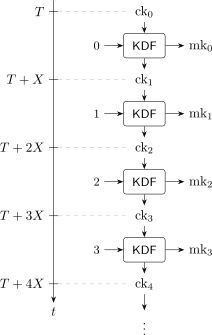
Helpfully, many of these devices have a GPS module, which provides a synchronised clock. This motivates a clock-synchronised symmetric ratchet:
- Preshare a chain key
, period , epoch . - Increment a counter
every mins — , where is GNSS-time. , where is the message key for period . - Keep message keys
in RAM; use these to receive messages. - Keep
stored in flash memory, overwriting when changes. Use this to rebuild the following keys after a power cycle. - Send messages using
.
A node which is added could be given
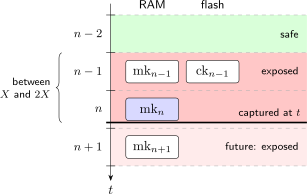
If an attacker reads key-state from the hardware, they’ll be able to decrypt up to the last
This is very similar to Signal’s symmetric-key ratchet, except that it is advanced by the passage of time.
Storage and messages
This would need, I think, 36 bytes of flash storage: 32 bytes for the chain key and say 4 bytes for a counter. Flash storage is pretty fiddly though and I could imagine there might be some issues with power loss mid-write.
Worse, repeated writes to flash storage wear it down. Pages on these chips can be erased something like 10,000 to 100,000 times before failure. At X=30 mins, this could cause a failure after 7 months of uptime. NOR flash allows writing zeros over a block without erasing a page, which could provide a route around this problem, but lots of popular flash chips do not. Even if it were supported in hardware, from what I know of Meshtastic, this would be a pain to implement. Their existing file system uses wear-leveling which would totally break the forward secrecy.
It will not be obvious which
What this doesn’t give you
Unlike other (better) systems, this scheme provides no post-compromise security. If an attacker is able to get physical access to a device and read the key, they could read all future messages on the channel. Signal solves this by adding a Diffie-Hellman ratchet, in which both parties in an exchange update a shared DH secret in each step, which seeds the KDF chain. I can’t think of an equivalent which can tolerate such unreliable message delivery and doesn’t add a lot of messaging overhead, but if you have one I’d love to hear it.
A motivated attacker could spoof GNSS signals to make the device roll forward the ratchet, and then it would be non-operational until reprovisioned. This could be mitigated with some kind of independent time-keeping.
This would not work with a number of Meshtastic features which allow messages to be delivered very late, such as MQTT bridging or Store-and-Forward. It would also require every node that can read messages to have GNSS, or some other accurate, trusted clock.
Conclusions
Although it is a serious proposal, this is mostly for fun, and I’m keen to hear any comments. I think the security of Meshtastic private channels under this proposal would be a dramatic improvement, but still very flawed. This would reduce some opportunistic attacks and prevent easy “harvest now, decrypt later” attacks. Ultimately securing unattended devices from a motivated attacker would require hardware changes and physical security.
Leave any technical commentary on the GitHub discussion.